


A dazzling symbol of the Renaissance and the legacy of the “prince architect” Francis I, the Château de Chambord has everything to seduce. Just 2 hours from Paris, this majestic edifice sits proudly in the heart of Europe’s largest enclosed forest park. And beyond its spectacular facades, its interior also reveals many wonders, some of which still intrigue history and architecture buffs. Although archives and plans have disappeared, Leonardo da Vinci is said to have designed the château. And one thing is beyond doubt: it took a genius of his calibre to imagine the extraordinary double-revolving staircase that can be admired in the heart of the keep.
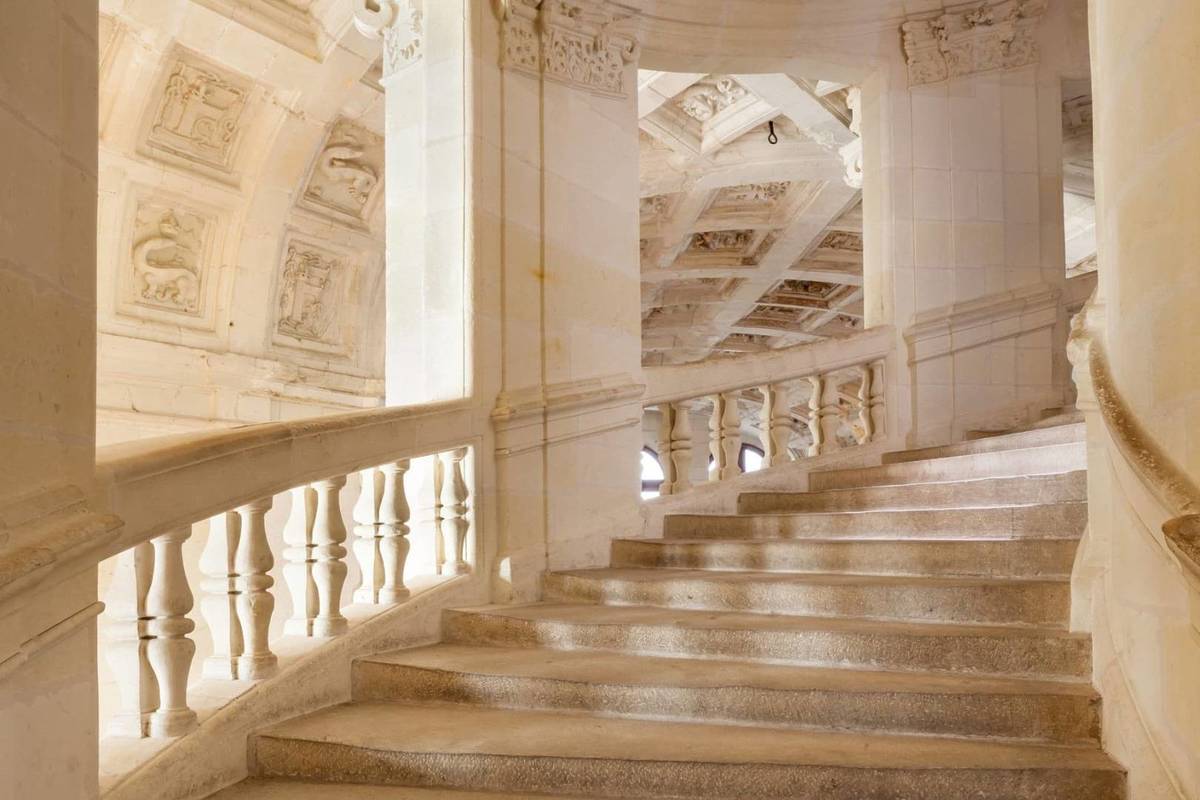
Chambord: dreamed by François I, imagined by Da Vinci?
Shortly after his victory at Marignan, François Iᵉʳ thought big. More than just a hunting lodge, he had a veritable architectural manifesto built, a dazzling symbol of the French Renaissance capable of impressing the courts of Europe. Although several architects took turns on the building site of this extraordinary secondary residence, no document reveals precisely who the true master was. One thing is certain: King François Iᵉʳ himself was involved in its design.
Many attribute the inspiration and plans to Leonardo da Vinci, who died at Le Clos Lucé in 1519, a few months before work began. Indeed, his notebooks abound with sketches of architectural elements that did indeed see the light of day at the château. It is also assumed that his disciple Domenico di Cortona, known as “Boccador”, produced a wooden model as early as 1517, proving that Italian inspiration loomed large over the project. This comes as no surprise, since Francis I was a great admirer of Italian art and techniques. In fact, Da Vinci’s documents include sketches of the famous double-revolution staircase, an extraordinary work for its time.
Architectural miracle: the double spiral staircase at Château de Chambord
Chambord boasts no fewer than 77 staircases. Most, like many other Renaissance châteaux, are simple straight staircases. But one stands out from the rest, and has continued to intrigue and fascinate visitors for centuries. It’s the double spiral staircase, also known as the double helix or double spiral. It’s nestled in the heart of the keep, beneath the majestic Tour-Lanterne, the castle’s highest point. This tower dominates the whole structure and crowns the staircase with its full height.
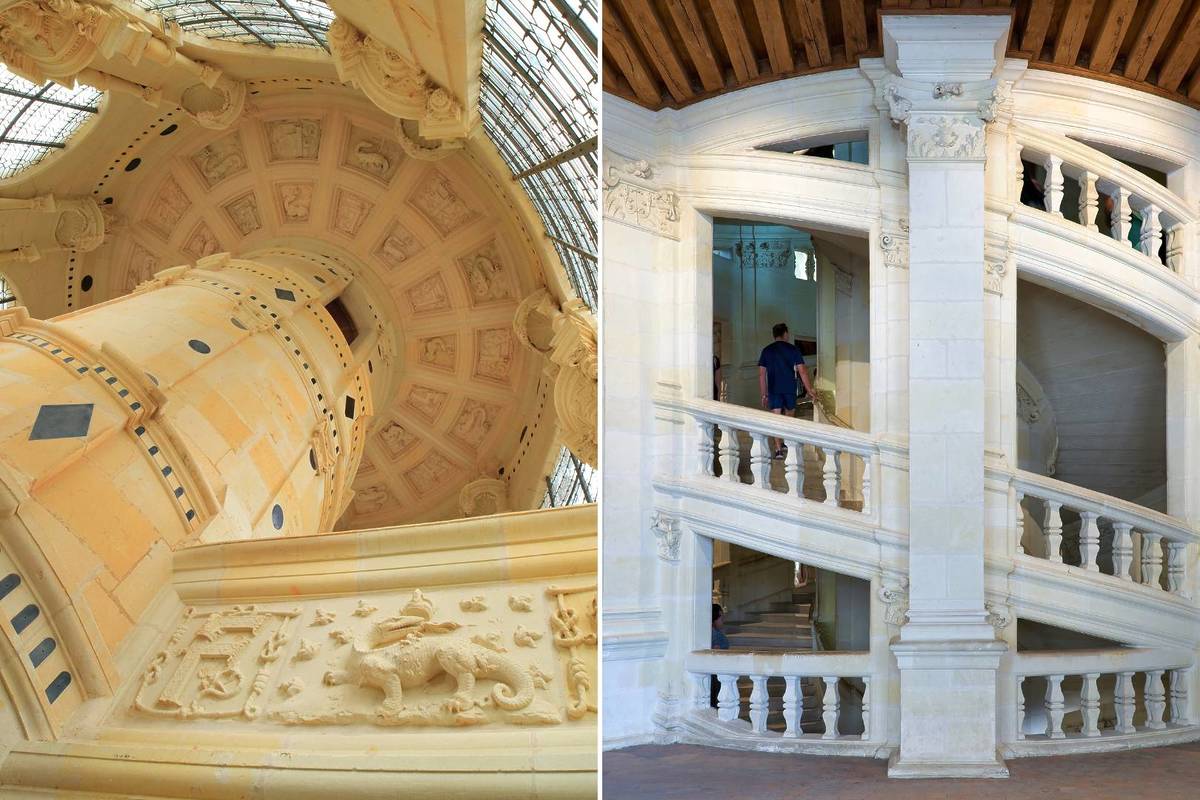
With its 9-meter diameter, two floors and accesses to the terraces, this unique staircase has two entrances on each level. In fact, it’s made up of two winding flights that never cross. As a result, two people can climb the staircase at the same time without meeting. An architectural feat designed to facilitate movement and avoid congestion, which proved to be a real revolution at the time. This helicoidal structure is so rare that even today, it’s hard to find any French equivalent dating from the same period. This masterpiece remains one of the great mysteries and jewels of Chambord.
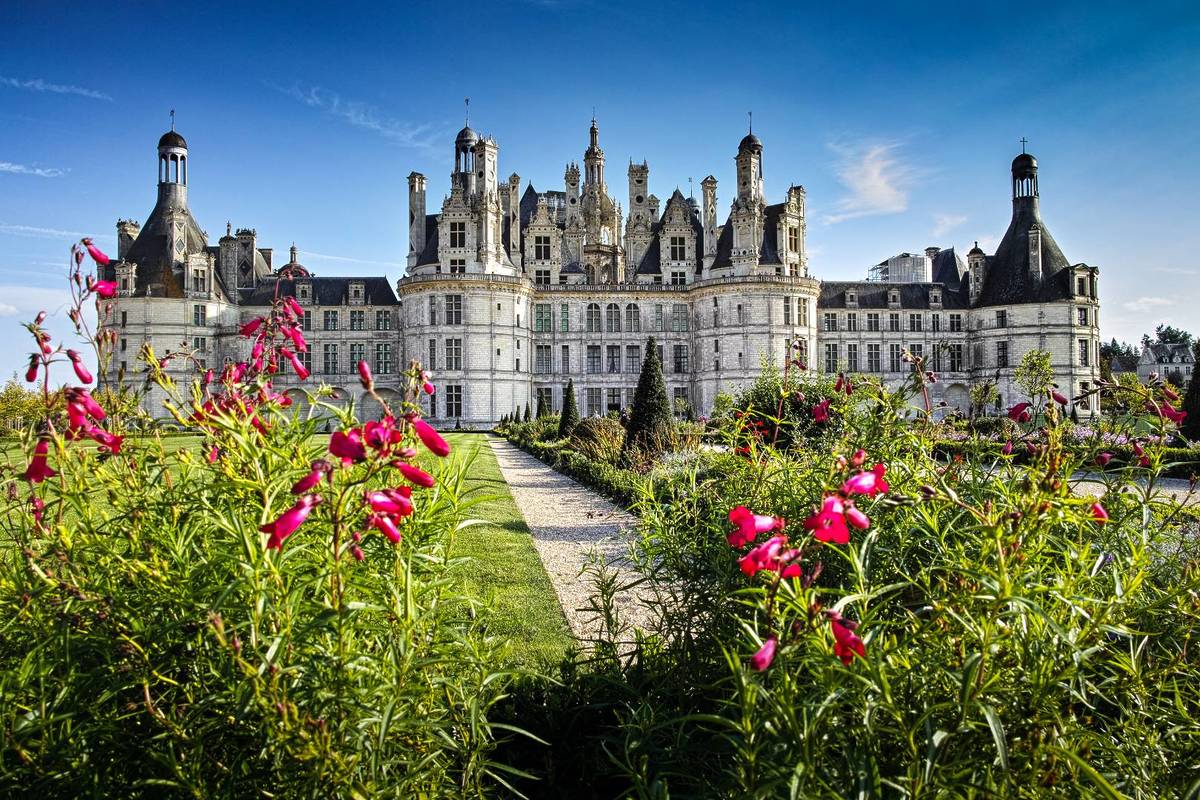
A castle of 1000 wonders
If you visit Chambord, you’re in for a real treat. The double-revolution staircase is just the first of many. Don’t miss the panoramic terraces, worthy of a real fairytale setting. Up there, you’ll have fun counting the 282 chimneys, dormer windows and sculpted spires. But above all, it’s the breathtaking view over the formal gardens and the immense estate that will captivate you. At 5,400 hectares, it’s the largest enclosed forest park in Europe. And to complete the visit, push open the doors to the richly decorated royal apartments, the light-filled chapel or the trophy room, all of which are reminders of just what an extraordinary monument Chambord is.