
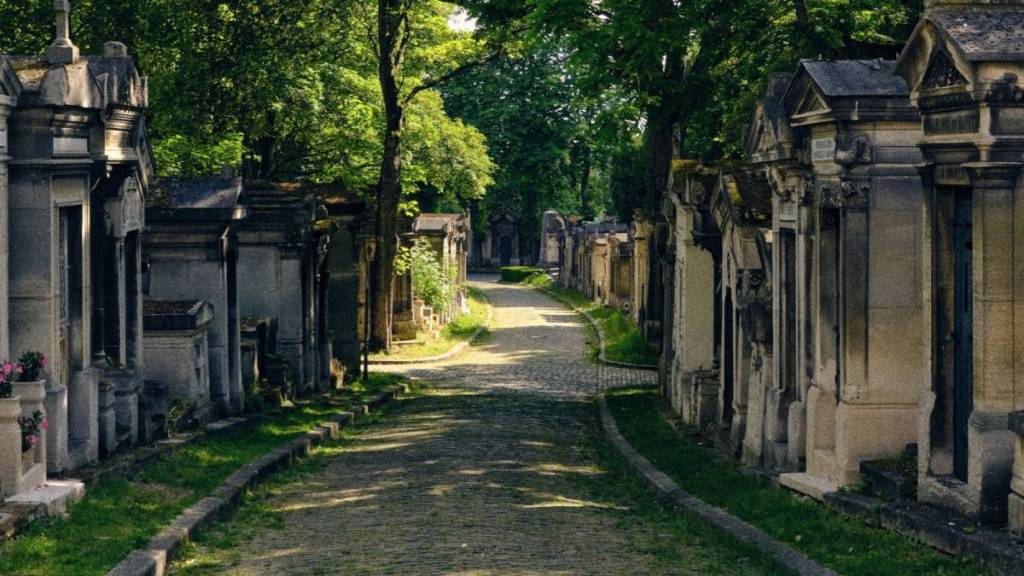

Jim Morrison, Édith Piaf, Oscar Wilde, Chopin, Molière… Père-Lachaise is now one of the most visited sites in Paris, with nearly 3 million visitors a year. Yet when the cemetery opened its gates in 1804, its success was far from certain. By the end of that first year, it had only 13 burial plots.
In just over two centuries, this plot of land—which was then located on the outskirts of Paris—has become a 43-hectare cemetery, known far beyond the capital and still used for thousands of funeral ceremonies each year.
From 13 plots to one of the most famous cemeteries in the world
When the Prefect of the Seine purchased the Mont-Louis estate in January 1804 to establish a new cemetery there, the site was still located outside Paris. Architect Alexandre-Théodore Brongniart envisioned a true garden cemetery, with tree-lined paths, groves, and tombs integrated into the landscape. But the concept struggled to gain acceptance. Père-Lachaise had only 13 plots in 1804, 44 the following year, and 49 in 1806. Even several years after its opening, the site remained far from the success that had been anticipated.
The Parisian authorities then came up with a rather modern idea: to attract prestigious occupants. In 1817, the remains of Héloïse and Abélard were transferred to Père-Lachaise. Today, the City of Paris itself describes the move as a form of “marketing campaign” intended to encourage Parisians to visit the cemetery. Molière and Jean de La Fontaine were also laid to rest there during this period. The strategy worked. By 1830, Père-Lachaise already had 33,000 plots, whereas it had only 13 twenty-six years earlier.
Faced with this surge in popularity, the site had to expand rapidly. Originally covering about 17 hectares, it underwent several expansions in the 19th century to reach its current size of 43 hectares. The landscape changed as well: the winding paths of the original garden cemetery were joined by denser sections, laid out like actual stone streets.
Today, approximately 70,000 plots are located at Père-Lachaise. Over time, historical figures have been joined by personalities who have become world-famous, from Marcel Proust to Jim Morrison, including Édith Piaf and Yves Montand. Yet the site remains much more than an open-air museum: it is still an active cemetery and hosts nearly 10,000 funeral ceremonies each year.
It is therefore hard to imagine, as you pass visitors from all over the world in its paths today, that Père-Lachaise was once a place Parisians were reluctant to embrace.
Location: Père-Lachaise Cemetery, 28 ter boulevard de Ménilmontant, 75020 Paris
Hours: Open daily; free admission; hours vary by season in Paris