
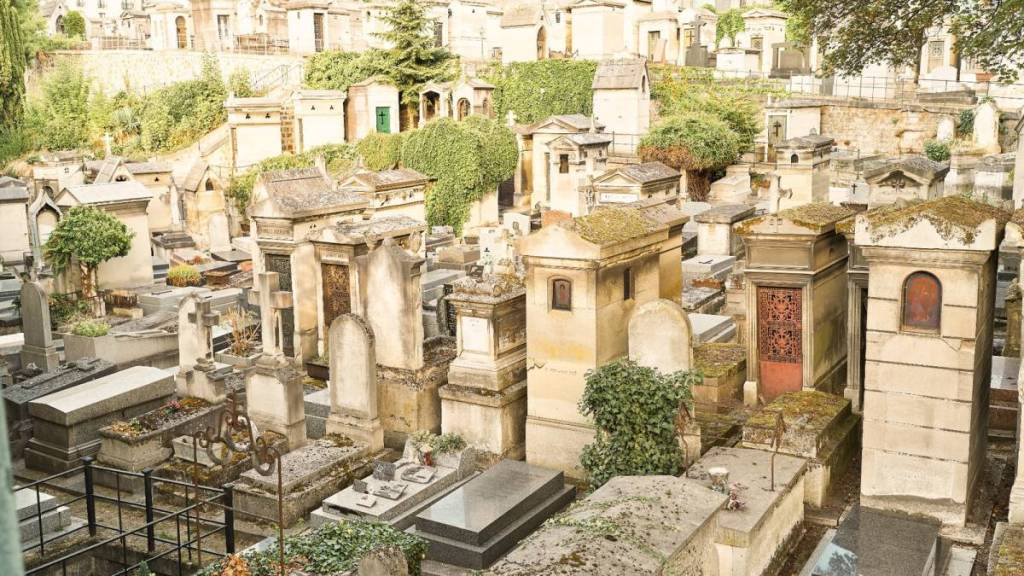

People come to Père-Lachaise to visit the graves of Molière, Édith Piaf, or Oscar Wilde. But behind its long avenues and sometimes impressive tombs lies a whole world of beliefs, legends, and rituals—some of which are rather dubious. Some stories are based on real events. Others have grown over the decades until they’ve become inseparable from the cemetery. Before your next stroll, here are 5 stories you should know to see Père-Lachaise in a whole new light.
Countess Demidoff and the Incredible Challenge of Her Tomb
There’s no better place to start. The immense mausoleumof Elisabeth Demidoff, a Russian aristocrat who died in the 19th century, is steeped in one of Père-Lachaise’s wildest legends.
At the end of the 19th century, a story began circulating in the press. The countess was said to have bequeathed her immense fortune tothe person capable of remaining sealed inside her tomb for 365 days and 366 nights, without ever leaving her remains. The legend even spoke of a glass coffin and a fortune of several million rubles.
The legend goes even further: three men, including an American and a Swiss, are said to have attempted to take on the challenge. None of them is said to have made it to the end. Some accounts say they gave up after a few weeks, completely terrified by the experience.
The problem? The legend has been debunked. The curator of Père-Lachaise explained as early as 1896 that the story originated solely from a newspaper. But the tale had spread so widely that thousands of people reportedly wrote in to try their luck. More than a century later, this strange countess continues to fuel the cemetery’s folklore.
The Ghosts of the Commune, Born of a Very Real History
The legend actually stems from a much more tragic event.
In 1871, the final battles of the Paris Commune reached Père-Lachaise. About 200 Communards took refuge in the cemetery, and the fighting continued right among the graves. 147 Federates were then executed by firing squad against the wall that bears their name today.
Over time, the place has also become steeped in far more mysterious tales. Some claim to have glimpsed silhouettes among the graves or heard whispers in the alleys. This is how the stories of the “ghosts of the Commune” came to be. No apparitions have ever been proven, but the legend has become persistent enough to be included in the tours of Père-Lachaise dedicated to the occult.
And this story remains very much a part of real life: every year in May, a commemoration is still held at the Wall of the Federates. A plaque has also marked the site of the executions since the early 20th century.
Allan Kardec and the Tomb Said to Grant Wishes
In the 44th division lies one of Père-Lachaise’s most recognizable graves: thatof Allan Kardec, the founder of Spiritism, situated beneath a granite dolmen.
According to legend, you’re supposedto touch her bust while making a wish, then return to lay flowers if it comes true. There’s no proof that Kardec himself requested this ritual. Yet the tradition continues to attract many visitors.
Some visitors claim to have actually seen their wishes come true. In a study devoted to the tomb’s regular visitors, ethnologist Emma Gobin recounts that the devotees she met said they had received at least one “grace” after visiting. A job found, a hoped-for recovery, a stalled administrative process resolved… the requests vary widely. Those who believe their prayers have been answered then return to lay flowers on the grave to thank Kardec. This tradition also explains why his grave remains one of the most heavily adorned with flowers at Père-Lachaise.
Victor Noir: A Grave That Became a Good-Luck Charm for Lovers
Victor Noir’s tomb simply depicts a young man lying down. But certain parts of the statue shine much brighter than others.
According to legend, touching certain parts of the statue is said to promote fertility or virility. Touching the feet is said to help you find love, whilekissing her face is said to bring back a lost love. The ritual is said to have emerged in the 1960s.
And some people take the tradition very seriously: flowers—and even baby booties—have been placed in the hat of the recumbent statue, as if to thank Victor Noir after a pregnancy.
Some female visitors even say they tried the ritual before becoming pregnant. In 2017, an American woman who had documented her fertility journey recounted coming to place a flower on her grave during a trip to Paris. A few months later, she announced her pregnancy and cited this visit as one of the things that helped her conceive. It’s impossible to establish a link between her pregnancy and the ritual. But she’s far from the only one to associate the tomb with motherhood.
Jim Morrison and the photo said to have captured his ghost
Among the more recent stories at Père-Lachaise, that of Jim Morrison is probably the most famous. In 1997, rock historian Brett Meisner had his picture taken in front of the Doors’ lead singer’s grave. At the time, nothing seemed out of the ordinary. It wasn’t until several years later, when he looked at the photo again, that he noticed a white figure behind him, arms outstretched, that strangely reminded him of Morrison.
The negative was then examined, and no obvious retouching was found, although this obviously doesn’t prove that a ghost appears in the photo. Some see it simply as a lighting effect or a shape cast in the background. Others continue to view it as one of the most unsettling apparitions associated with the cemetery.
The story doesn’t end there. Meisner later recounted that this photo had brought him bad luck: his marriage had ended, a loved one had died of an overdose, and strangers had even begun showing up at his home claiming to have messages from Jim Morrison. He himself said he regretted keeping the photo. Once again, it is impossible to establish a link between these events and the photograph, but this succession of stories has largely contributed to transforming the photograph into a true modern legend of Père-Lachaise.