
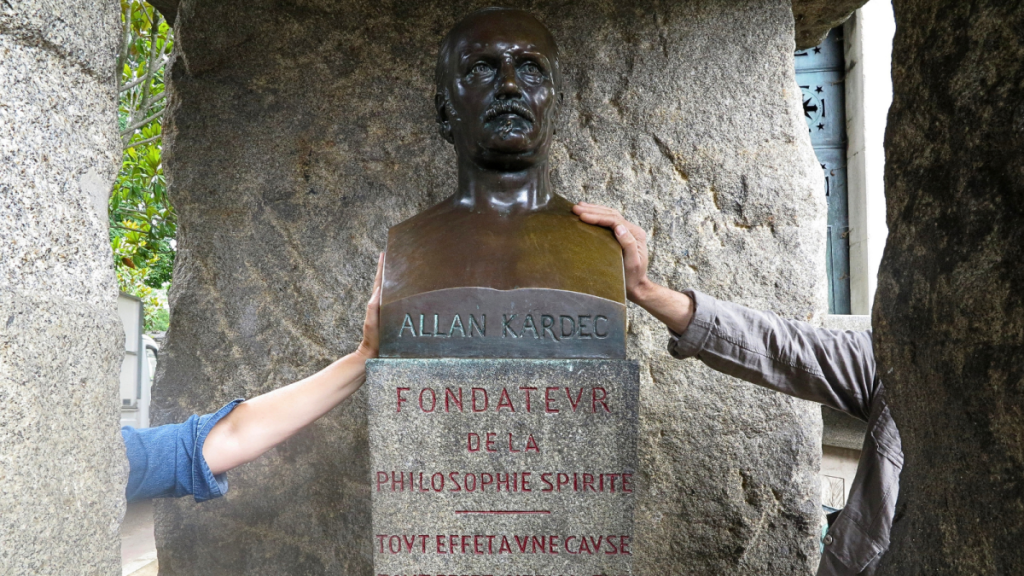

Sometimes you have to stray from the most-traveled paths of Père-Lachaise to stumble upon the strangest stories. In the 44th division, an imposing stone dolmen catches the eye. At its base, flowers. Lots of flowers. This is where Allan Kardec—whose real name was Hippolyte Léon Denizard Rivail—rests , considered the founder and codifier of Spiritism in the 19th century. A title that is, in fact, engraved on his tomb, where the inscription reads “Founder of Spiritist Philosophy.” A French educator and writer, Allan Kardec devoted his research to the philosophical and scientific study of communication with spirits.
And today, his grave is renowned for being one of the most flower-covered in the cemetery. But it’s not the flowers that attract the curious… rather, they are a testament to what some people come here seeking…
What is the story behind this grave, which is said to have the power to grant wishes?
For years, a strange legend has circulated about the grave. Allan Kardec is said to have indicated during his lifetime that, after his death, visitors could place their hand on the back of his bust, make a wish, and then return with flowers if the wish came true. It’s a story that cannot be verified as historical fact, yet it continues to fuel the ritual that many visitors still participate in.
Flowers as a token of gratitude
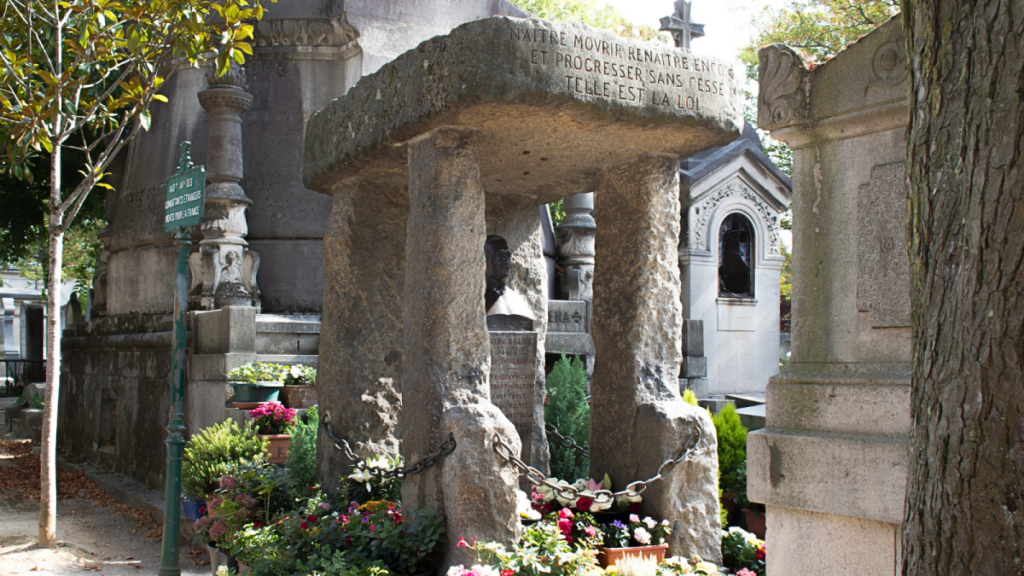
One need only look at the tomb to understand why the legend endures. Slightly weathered, the bronze bust appears to have been touched countless times by the hands of visitors. Around the dolmen, bouquets pile up, left by those who come to pay their respects—or, perhaps, to ask for something that ordinary life seems unable to give them.
Perhaps most troubling is that the belief has become popular enough that a message on the back of the monument now urges visitors not to repeat this ritual, which is considered more a matter of superstition.
The legend is thus disproved by the stone itself, while the flowers, for their part, seem to continue telling a completely different story.
Between belief and mystery, a grave unlike any other
Thus, among the silent graves of Père-Lachaise, Allan Kardec’s grave possesses something almost alive. People come here with a question, a hope. And when they return to lay flowers, who knows what they are truly there to thank?
Coincidence? Faith? Or that mysterious human need to give thanks for what we cannot explain when, against all odds, a wish finally comes true.