
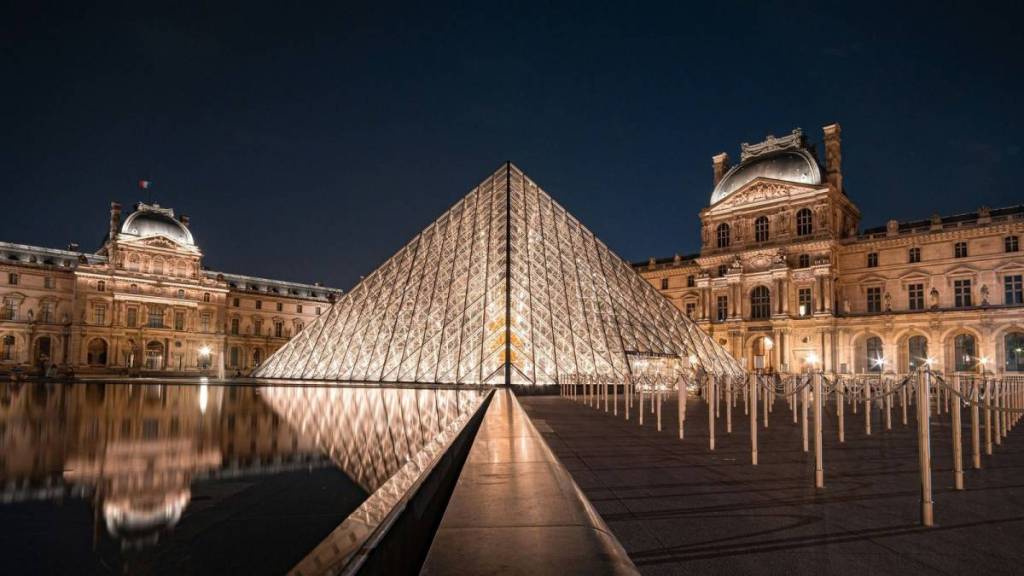

It’s hard to imagine the Louvre without its kilometers of galleries, the Mona Lisa, and the crowds thronging beneath the Pyramid. Yet when the palace officially became a museum in 1793, its first catalog listed “only” 537 paintings and 124 other objects. Today, the contrast is striking: in 2025, the Louvre welcomed 9 million visitors.
In the intervening years, more than two centuries of acquisitions, architectural transformations, and expansions have transformed a former royal palace into one of the most visited museums in the world.
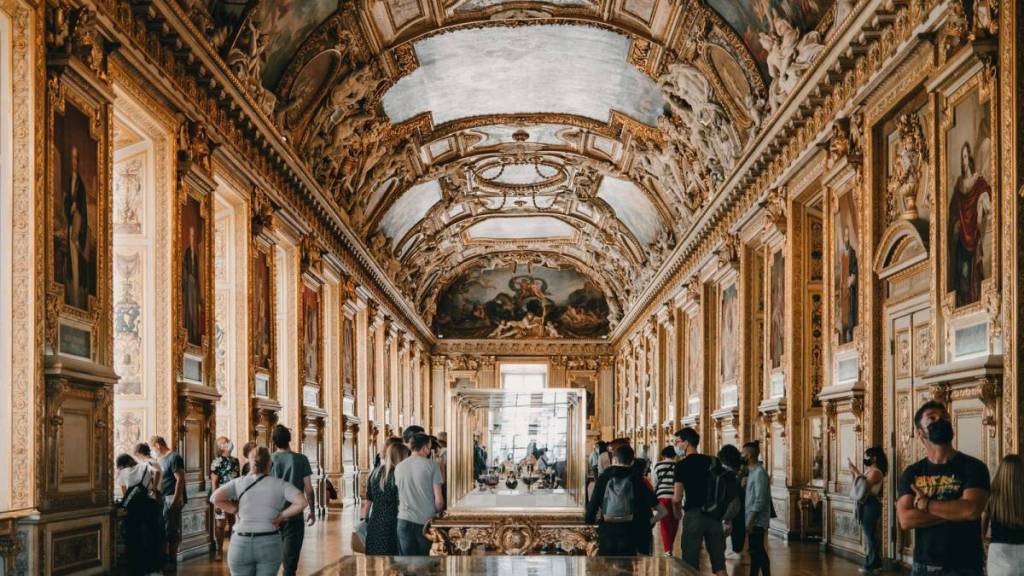
In 1793, the Louvre’s 537 paintings could essentially all fit into the Grande Galerie
The Louvre was obviously not built to become a museum. Originally, Philip Augustus had a fortress built on this site at the end of the 12th century. The building later became a royal residence before being gradually expanded by French monarchs.
Everything changed with the French Revolution. In 1791, the National Assembly decided to dedicate the Louvre to the arts, and the Central Museum of the Arts was created two years later. Its symbolic opening took place on August 10, 1793, amid a political climate that was turbulent, to say the least. The museum quickly closed for renovations before the public was finally admitted on November 18.
At that time, a large portion of the collection was displayed in the Grande Galerie, the long hall that still runs along the Seine today. The museum’s first catalog, printed in 1793 and preserved at the Bibliothèque nationale de France, lists precisely 537 paintings and 124 miscellaneous objects.
The collections originate primarily from the former royal collection, which was soon supplemented by revolutionary confiscations. They were then significantly expanded in the 19th century, notably through acquisitions, donations, and works that arrived in France during the Napoleonic period.
In 2025, 9 million visitors came to the museum, an official figure that is consistent with recent years: there were 8.9 million in 2023 and 8.7 million in 2024.
In the meantime, the Louvre has also gradually taken over nearly the entire former royal palace. One of its most visible transformations took place between 1981 and 1989 with the Grand Louvre project and the construction of the Pyramid, designed in particular to reorganize the reception of a public whose numbers had grown beyond comparison with those of 1793.
In short, 537 paintings were on display when the museum first opened, and more than two centuries later, it attracts 9 million visitors a year. And behind the monumental façade of today’s Louvre, the Grande Galerie—where it all began—remains one of the museum’s must-see highlights.