


Everyone knows Rodin’s The Thinker. But almost no one knows what he’s looking at. The statue, located in the garden of the Rodin Museum, represents for many the timeless image of the dreamer… but the artist never intended this work to depict a man lost in his thoughts. It was designed to sit above a doorway and look down. Let us explain!
Originally, it wasn’t “The Thinker”—it was Dante
In 1880, the government commissioned Rodin to create a monumental door for a Museum of Decorative Arts that would ultimately never be built: The Gates of Hell, inspired by The Divine Comedy by the Florentine poet Dante Alighieri. Originally, the door was to have been adorned with the statue of The Thinker, installed in the tympanum.

This figure actually depicts Dante himself, leaning forward, observing the circles of Hell he had just written about. Some interpreters have also seen in it Chronos, Hades, or the creator contemplating his work, even though the museum itself doesn’t settle the matter. In any case, one thing is certain: nothing resembles the tranquil reverie attributed to him. Even his posture in no way suggests rest: his toes cling to the base, his left fist is clenched against his knee, his back is tense, and his right elbow rests on the opposite thigh in a twisted position that no body can maintain for very long.
Rodin’s sculpture thinks with its muscles, not with its brow. The figure was exhibited on its own for the first time in 1888 and was enlarged in 1904. It remains one of the most widely reproduced works in the entire history of French sculpture.
It stood in front of the Panthéon for sixteen years, then was installed in a three-hectare garden
Before being installed in the garden of the Rodin Museum, The Thinker stood in front of the Panthéon for 16 years. Now placed among the boxwoods on its pedestal, it faces The Gates of Hell, installed at the far end of the garden. The Poet and his gate thus gaze at each other once again, just a few dozen meters apart. Around them, The Burghers of Calais call out to passersby on Rue de Varenne, Ugolin stands majestically in the middle of the pond, and Balzac leans against the silhouette of Les Invalides. The garden is included with admission, so be sure to buy your tickets for the Rodin Museum and set aside a good hour to explore the outdoor area.
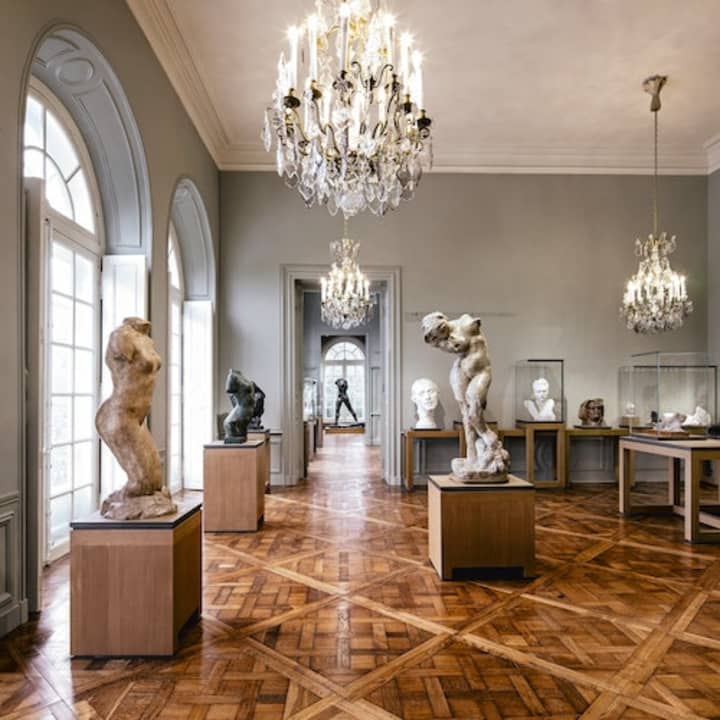
Musée Rodin : billets coupe-file - 4.85 · 72 reviews
And if you’d rather avoid the crowds, head to Meudon, to the Villa des Brillants park, where another monumental version stands guard over the grave of Rodin and his wife, Rose Beuret.