
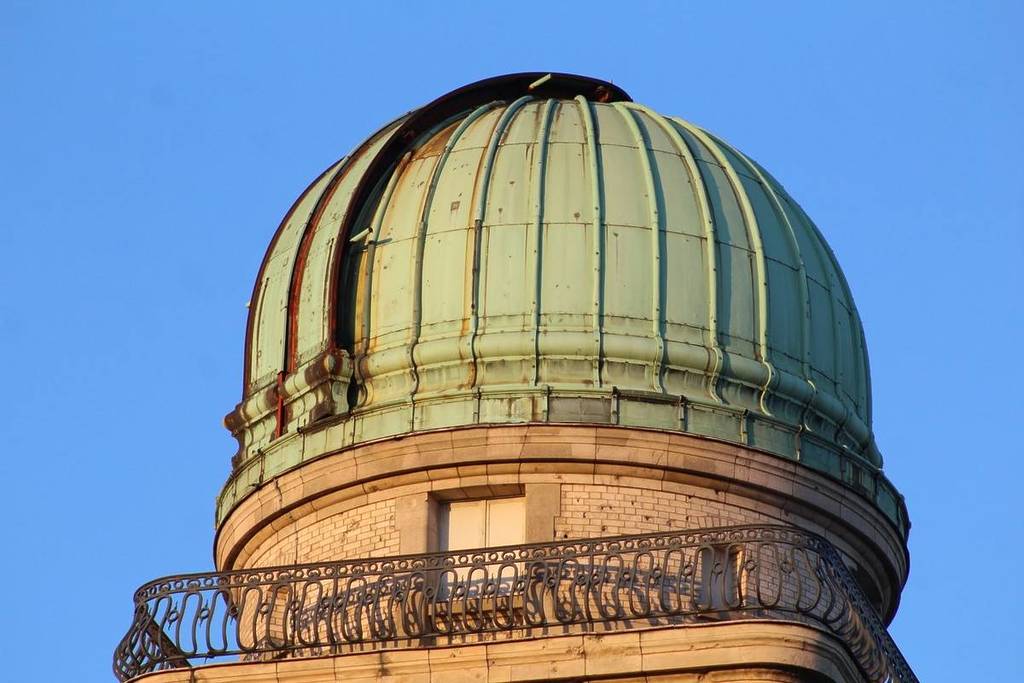

Perched above Rue Saint-Jacques, theSorbonne Observatory tower houses beneath its green dome a monumental astronomical telescope over six meters long.
Even before entering the building, the tower’s facade reveals a slice of history: its stones still bear the bullet marks left by German snipers during the Battle of Paris.
A panoramic view of Paris and precision engineering
Before reaching the optical instrument, the ascent passes through former offices that offer an unobstructed view of the cityscape. From these windows, the Parisian skyline unfolds unimpeded, revealing the Eiffel Tower, the structure of the Beaubourg Center, and the spires of Notre-Dame.
The main attraction, however, lies beneath the dome, impressive for its soaring ceilings. The 1930s telescope, though smaller than the original model that nearly touched the walls, allows you to bring the moon closer for observation.
The entire dome, weighing nearly seven tons, rests on a circular rail. Its gear mechanism allows visitors to rotate it manually, without any physical effort, to align the aperture with the targeted celestial body.
While nighttime visits are recommended for observing the planets and stars, sessions held in the middle of the day focus on the sun. To avoid any risk of eye burns, the team uses the telescope like a projector. The light passes through the instrument and is projected onto a simple white sheet of paper.
This indirect method allows for the clear identification of sunspots, each of which has a surface area roughly equivalent to that of Earth.
The walls of the room are covered with astronomical data, ranging from graphs of planetary trajectories to photographs taken by this very telescope. Guides explain the history of the moon, preserved from erosion by wind and rain, offering an unspoiled view of craters formed by meteorite impacts dating back billions of years.
These celestial tours are organized by the Société Astronomique de France (SAF). Tickets, priced at 15 euros, must be reserved on the association’s website. Since slots are in high demand, it is necessary to plan your visit in advance.
On the way down, one last glance from the roof offers a view of the beehives set up below on the roofs of the Sorbonne.