
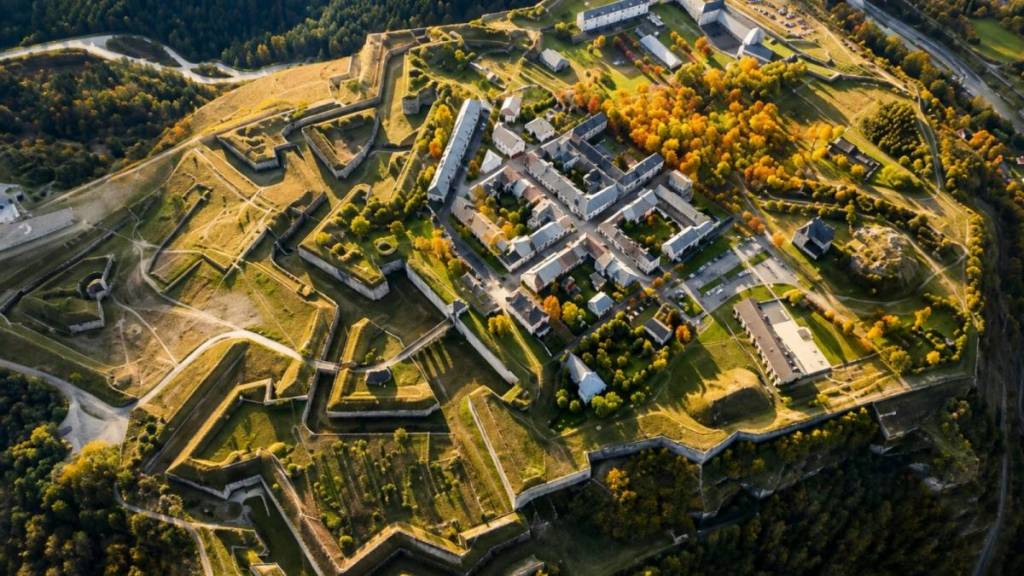

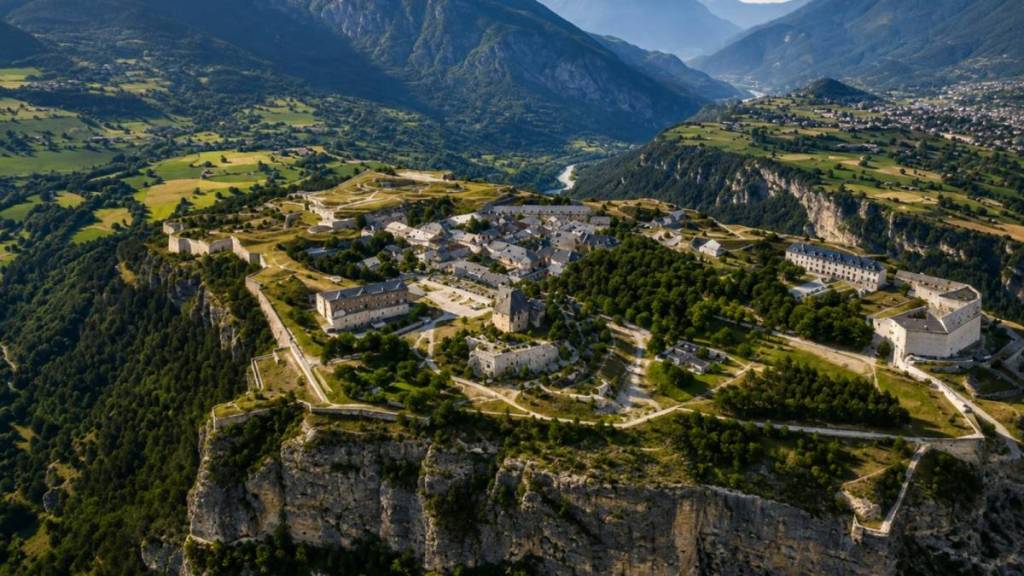
It doesn’t really fit the classic image one might have of a typical Alpine village. In Mont-Dauphin, there are no chalets scattered across the slopes: visitors enter through fortifications before discovering straight streets, old barracks, a powder magazine, and houses built behind thick ramparts. Perched at an altitude of 1, 050 meters, between the Guil and Durance valleys, the village joined the “Most Beautiful Villages of France” network in June 2025. It was already listed as a UNESCO World Heritage Site for its Vauban fortifications.
The town is both an inhabited village and a former military stronghold almost entirely designed by Vauban. Its history began after the 1692 offensive led by Victor Amadeus II of Savoy in the Haut-Dauphiné. Louis XIV then asked his architect to reinforce this particularly vulnerable border. Vauban chose a naturally defended rocky plateau and envisioned not only a fortress but a veritable small town where soldiers and civilians would live together.
Mont-Dauphin, a village fortified by Vauban and designated a UNESCO World Heritage Site
Mont-Dauphin was intended to halt enemy armies before they could advance into the interior of the kingdom. The fortifications appear to have fulfilled their purpose: the fortress was never besieged. The shifting of the border following the Treaty of Utrecht in 1713 quickly diminished its strategic importance, even though construction continued well beyond Vauban’s time. Its only true military episode occurred in 1940, when an Italian bomb struck the site.
Today, a stroll through the village already allows visitors to see much of the ramparts and civilian buildings. For a more in-depth exploration, guided tours take visitors through the moats, the Arçon lunette and its underground passage, the arsenal, the powder magazine, and even the attic of the Rochambeau barracks. From the fortifications, the views open up onto the Queyras, the Durance Valley, and the Écrins Massif.
Inside the Rochambeau barracks, 35 monumental sculptures by Ousmane Sow reenact the Battle of Little Bighorn, featuring notably Sitting Bull and Crazy Horse. This artwork made a strong impression in Paris when it was exhibited on the Pont des Arts in 1999 before being moved to Mont-Dauphin several years later.
Mont-Dauphin thus makes for an excellent stopover during a trip to the Hautes-Alpes: small enough to explore on foot, yet with enough historical sites to spend several hours there. And unlike many citadels that have been turned into monuments, this one remains , above all , a living village, simply surrounded by one of the most impressive defensive systems ever devised by Vauban.
Location: Fortified Village of Mont-Dauphin, 1 Place Vauban, 05600 Mont-Dauphin