
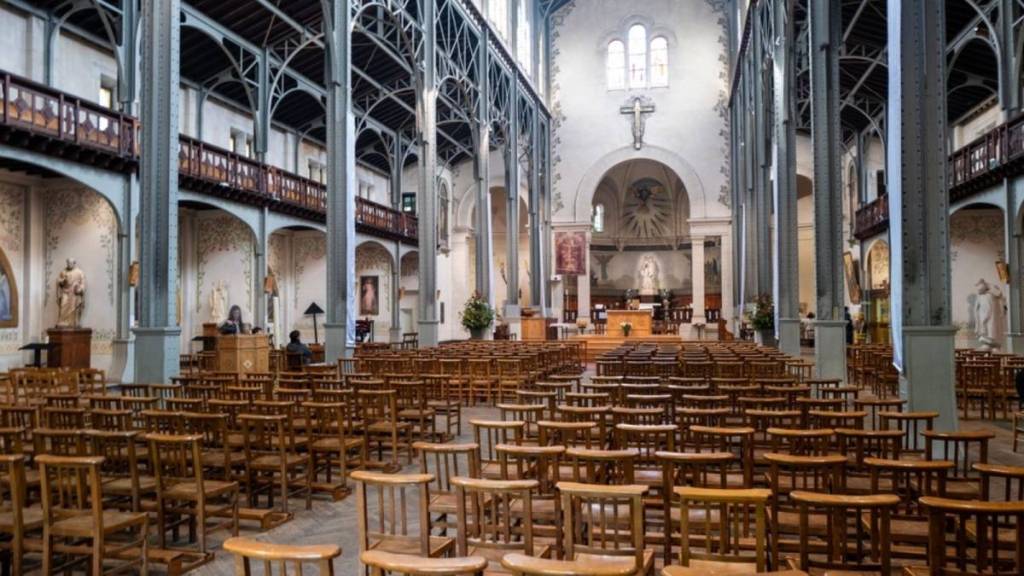

From the outside, there’s nothing to really hint at what awaits visitors. Located in the 14th arrondissement, Notre-Dame-du-Travail initially looks like a fairly unassuming neighborhood church. But once you step through the door, the scene changes completely: the nave is spanned by a massive exposed steel framework that is more reminiscent of a train station or an industrial warehouse than a religious building. On September 19 and 20, 2026, European Heritage Days will offer the chance to explore it for free, with several guided tours scheduled for Saturday.
The church was built at the very end of the 19th century in a neighborhood that was then largely populated by workers. The architect, Jules Astruc, was given a rather unusual directive: to create a space where these workers could find materials and an aesthetic familiar to their daily lives. The metal structure thus became central to the project. Some of the materials used came from the Palais de l’Industrie, built for the 1855 World’s Fair and later dismantled to make way for the Grand Palais and the Petit Palais. In total, approximately 135 metric tons of iron were incorporated into the building.
Notre-Dame-du-Travail, a church that resembles an industrial hall
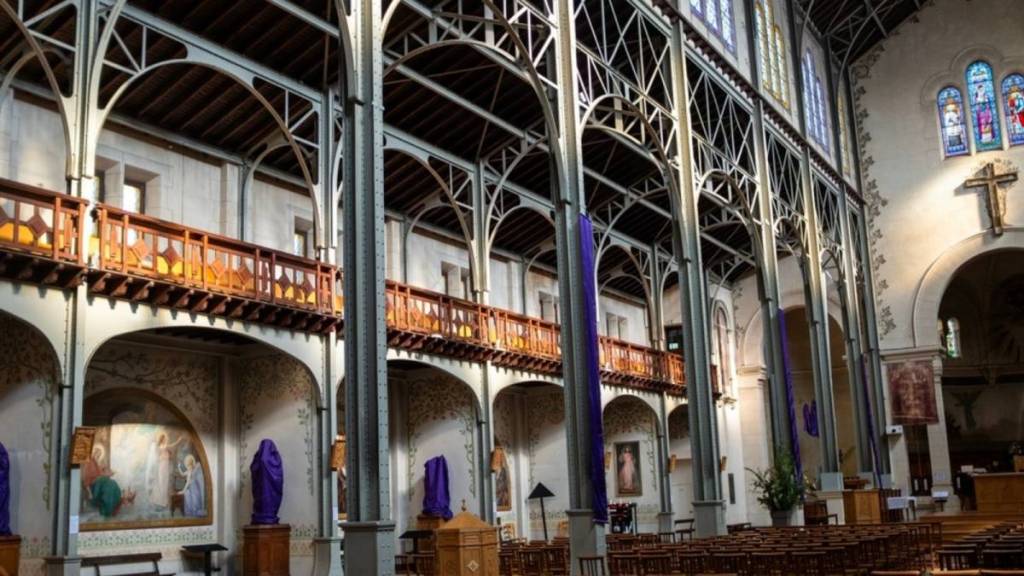
Inside, metal pillars, riveted arches, and a structural framework deliberately left exposed give the nave a look very different from that of the great classical Parisian churches. This aesthetic also addressed an economic constraint: metal allowed for rapid, low-cost construction while spanning a large space without the need for multiple load-bearing walls.
For the 2026 European Heritage Days, the church will be open for self-guided tours on Saturday, September 19, from 9 a.m. to 6 p.m., and on Sunday, September 20, from 1 p.m. to 6 p.m. Four guided tours are also scheduled for Saturday, with the meeting point under the grand organ.
Location: Notre-Dame-du-Travail, 59 rue Vercingétorix, 75014 Paris