
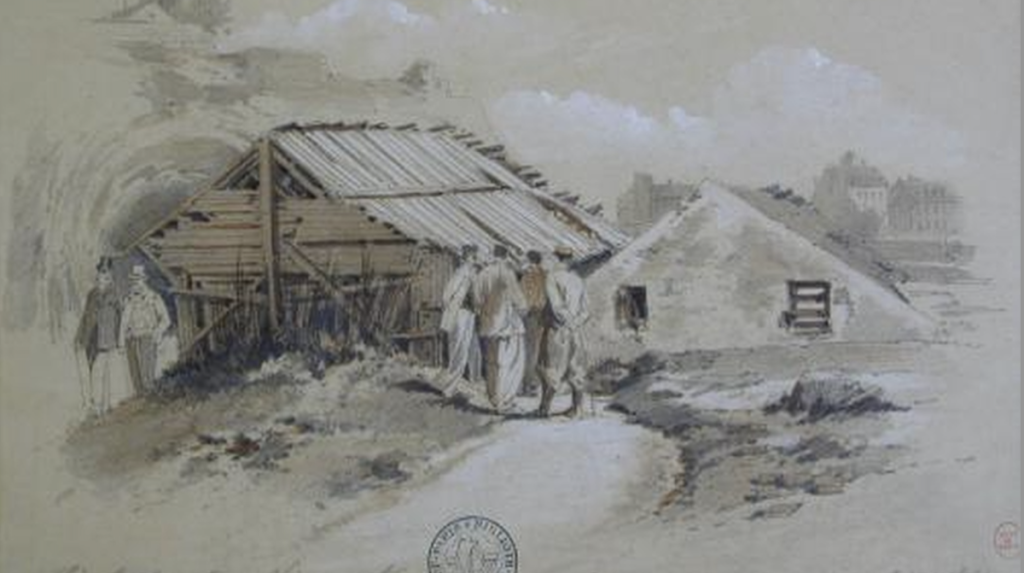

With its cobblestone streets, lively terraces, and artists gathered at Place du Tertre, Montmartre has become one of the most romantic neighborhoods in Paris. Yet it’s hard to imagine that, long ago, this very hill was riddled with quarries where workers toiled. Long before it became one of the capital’s must-see destinations, the Montmartre hill supplied the plaster used in the construction of Paris. This activity transformed its landscape, with origins dating back nearly 2,000 years. Even today, certain spots in the neighborhood bear traces of this little-known past.
Long before the artists arrived, Montmartre was a land of quarries
The history of Montmartre begins long before the arrival of artists—and even before the Paris we know today. We have to go back nearly 2,000 years, to the Gallo-Roman era, to find the first traces of quarrying on the hill. At that time, the hill possessed a rare resource: gypsum. When heated, this rock could be used to make plaster, a material that played an important role in the construction of Paris.
And Montmartre didn’t take long to change its character. Where people stroll today, generations of workers dug into the hill to extract rock. Over the centuries, the quarries grew larger, and some even extended underground. The gypsum was transformed into plaster in kilns set up all around the hill. It’s hard to imagine this activity amid the bustling alleyways and terraces we know today.
Montmartre played an important role in the development of Paris. And yet, at that time, the neighborhood was a far cry from the image we associate with it today. Alongside the quarries, the landscape was still marked by vineyards, windmills, and farmland.
In the 19th century, Montmartre took on the appearance of an open-air construction site
It was especially during the 19th century that quarrying reached its peak. Paris was expanding, construction was booming, and the demand for plaster was rising. On the Montmartre hill, workers extracted ever-greater quantities of gypsum to meet the capital’s needs.
At that time, plaster from Montmartre was in high demand. It was used to build and renovate many Parisian buildings, to the point that the hill became one of the capital’s main sources of supply. But intensive mining eventually weakened the hill. As a result of all the digging, the ground became unstable and the risk of collapse increased. Starting in 1860, when Montmartre became a district of Paris, the quarries were gradually closed and stabilized.
Little by little, the landscape changed. The old quarries disappeared, but streets, residents, and places of entertainment filled the hill. At the end of the 19th century, artists began settling on the hill one after another. Montmartre began to take on the character we all recognize today.

The quarries are gone, but their history is still visible in Montmartre
Louise-Michel Square, which we now cross to reach the Sacré-Cœur, has a unique history. Its gardens were laid out on the site of former gypsum quarries. But building a park on land weakened by centuries of mining was no easy task. The ground had to be stabilized, which explains why the garden—conceived in 1880—was not completed until 1932.
But it’s not the only place with this history. The Montmartre Cemetery was also built on the site of former quarries. And the name of the Grandes-Carrières neighborhood preserves the memory of this activity.
It’s hard today to find the Montmartre of laborers and plaster kilns behind its gardens and bustling alleyways. Yet this history hasn’t completely disappeared. It can be found in the hill’s contours, in certain place names, and in the old quarries that shaped the neighborhood long before the artists arrived.