
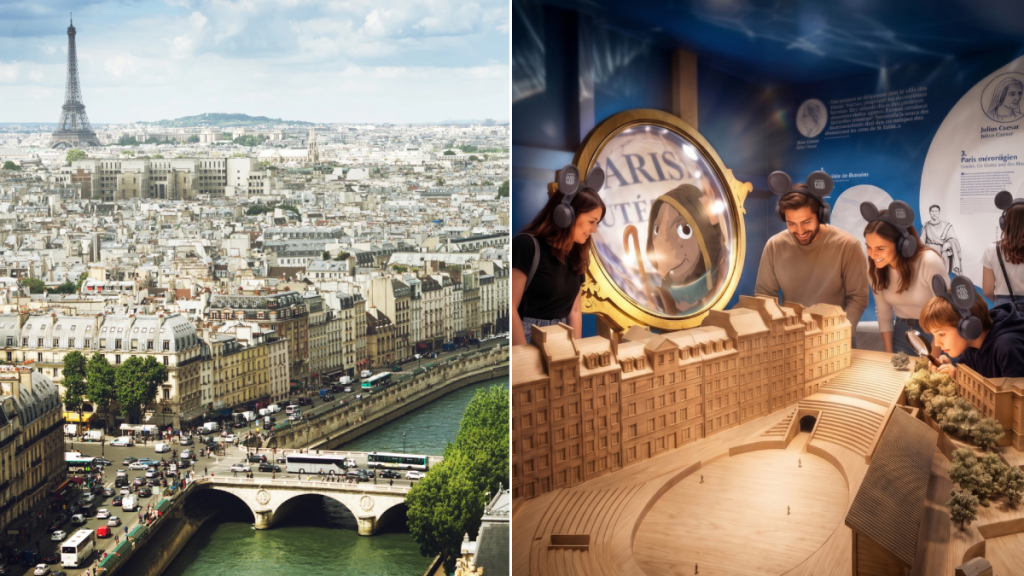

It begins with a shift in scale: as soon as you enter “Le Paris des souris,” you’re supposed to have shrunk, and everything around you becomes giant. Buttons, bottle caps, and subway tickets form a mountain that you can climb, slide down, and squeeze through to discover secret passages. The tour then takes visitors through ten eras of Parisian history, from Lutetia to Greater Paris, in sets built like movie sets. The guide is named Jean—a ten-year-old Parisian mouse—and his mouse holes have the unique ability to connect both streets and centuries.
On display at Planet Paris on Rue Saint-Dominique starting November 11 for six months, the exhibition is aimed at both children and their companions. The works are reproductions, drawn primarily from the Carnavalet Museum, the BnF, and the National Archives, and the tone is deliberately parodic, though the facts remain accurate.
66 Rue Saint-Dominique
From the Louvre to the Opera, ten sets to revisit the history of Paris
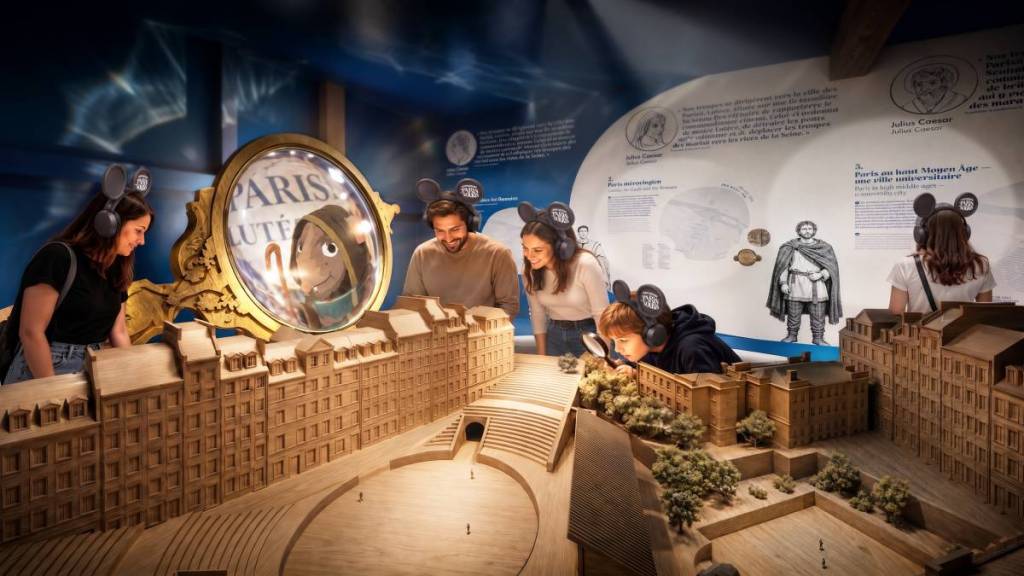
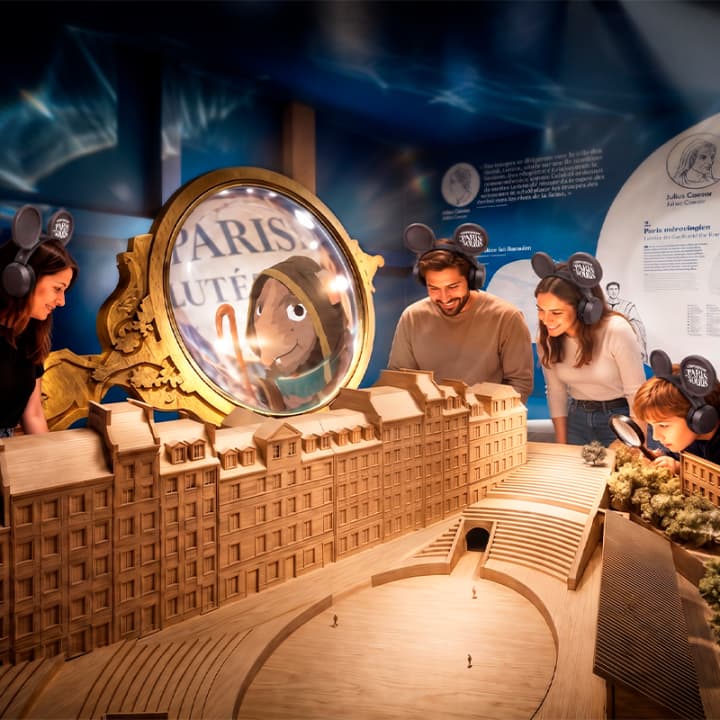
Each era has its own setting and character, and this is a far cry from a textbook summary. The tour begins in Lutetia, in a 13th-century scriptorium where an old archivist—who has read so much that he remembers everything—tells the story of the Parisii, the Gallo-Roman arenas, and a god few people know about: Apollo Smintheus, whom the Greeks called “Apollo of the Mice.”
At the Louvre, an animated film created especially for the occasion brings the palace to life in 3D right before your eyes, from Philip Augustus’s fortress to Pei’s pyramid, right up to JR’s magic trick that made it disappear in 2019. A little further on, head to a 17th-century drawing room at the home of Madame d’Aulnoy, to whom we owe the first fairy tale published in France. There, she hosts Madame de Sévigné and Madame de La Fayette around a set table, and it is, in fact, one of her tales that inspired the little mouse that collects baby teeth.
Next, we go behind the scenes at the Palais Garnier, where we learn that the Opéra’s “petits rats” owe their nickname to Théophile Gautier. The next stop is a recreated Belle Époque café, dedicated to two iconic Parisian spots: Le Rat Mort, a favorite among artists and writers (and whose name simply had to be included here), and Le Chat Noir, the cabaret that opened in 1881. As you move from table to table, you trigger a shadow play or a song. The tour ends on a festive note, under a giant mirror ball, with works by Blek le Rat, who had already been stenciling rats on the streets of Paris as early as 1981.
Designed for children, but not exclusively
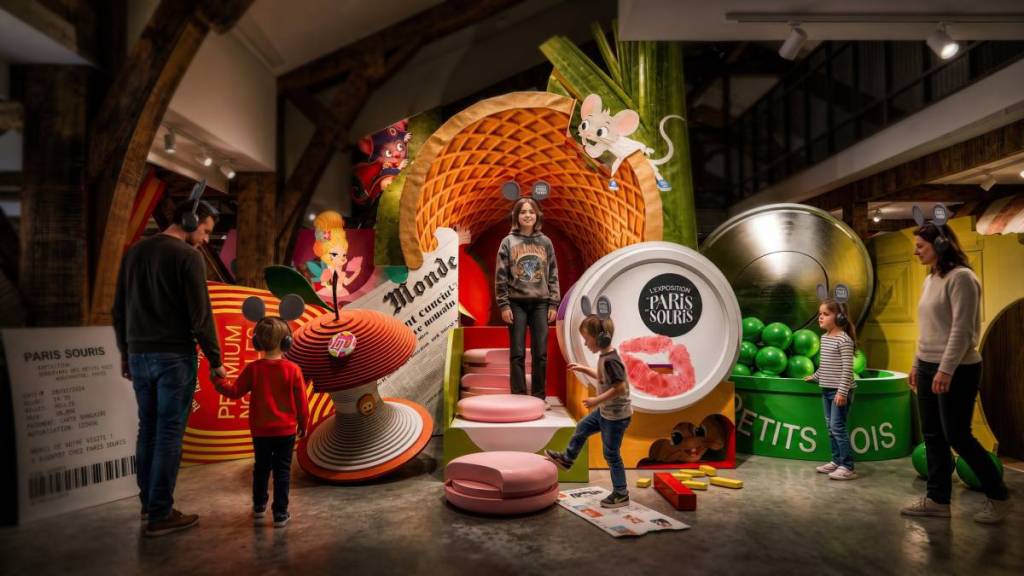
The highlight of the exhibition is that it works on two levels. Younger visitors search for the mice hidden in each set, while their parents recognize La Fontaine, Degas, or Victor Hugo as they pass through a scene. The designers have also limited the use of screens so that the visit remains a shared experience, with details to point out and questions to ask aloud.
Some sections are especially inviting to play with. You can transform a medieval alley into a Haussmann-style avenue, settle into the capsule that sent the rat Hector into space in 1963, or redraw Paris your own way with a giant computer mouse. Sound also adds to the atmosphere, with the noise of the Arènes de Lutèce, the hustle and bustle of Les Halles, and even a vintage recording of Aristide Bruant. An audio guide in six languages is included with the ticket for those who want to explore further.
The exhibition is located at 66 Rue Saint-Dominique and is open from 10 a.m. to 6 p.m. on Mondays, Tuesdays, and Sundays, and from 10 a.m. to 7 p.m. Wednesday through Saturday. Admission is €17.90 for adults and €11.90 for children, with a family package available for €13.90 per person (maximum of two adults). Admission is free for children under 3.
Le Paris des Souris – Liste d’attente
66 Rue Saint-Dominique