
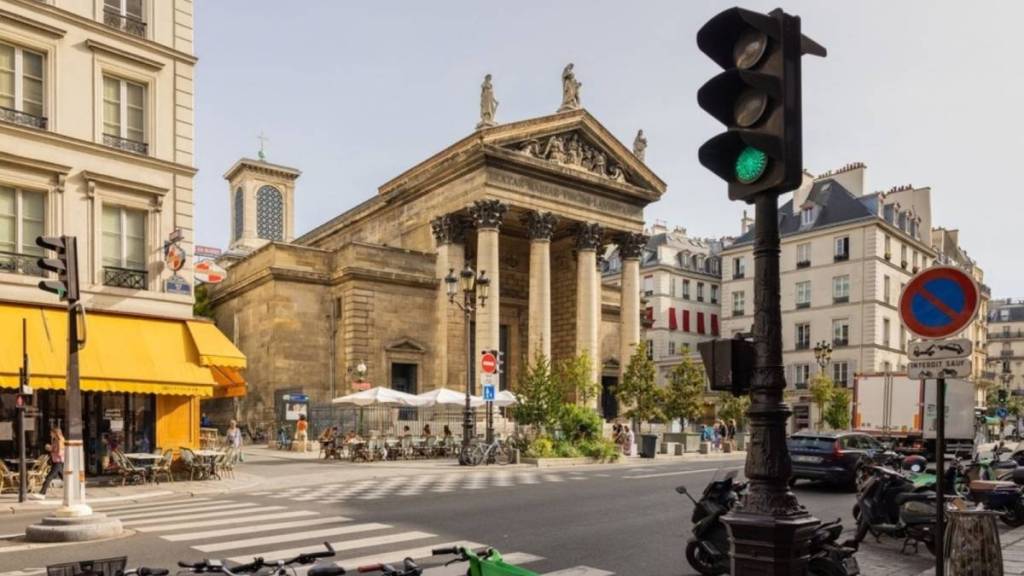

From the Rue de Châteaudun, Notre-Dame-de-Lorette could almost pass for an ancient temple. Yet one need only step through its doors to find a truly unusual interior: painted ceilings, brightly colored chapels, gilding, marble, and religious scenes fill virtually every part of the building.
The current church was built between 1823 and 1836, at a time when the neighborhood at the foot of Montmartre was undergoing a profound transformation. This was the era of “New Athens,” when artists, writers, and actors began settling there. Architect Louis-Hippolyte Lebas chose to draw inspiration from the early Christian basilicas of Rome, notably Saint Mary Major, rather than replicating the Gothic style still associated with many French religious buildings.
Notre-Dame-de-Lorette, a church with magnificent decor
Today, the interior offers a veritable panorama of French religious painting from the first half of the 19th century. Several artists were commissioned to decorate the various chapels and the nave, sometimes in very different styles. The murals were created using wax, a technique that was brought back into fashion during this period.
The life of the Virgin Mary is depicted along the nave, and in the baptistery, one can also see paintings by Adolphe Roger dedicated in particular to Emperor Constantine.
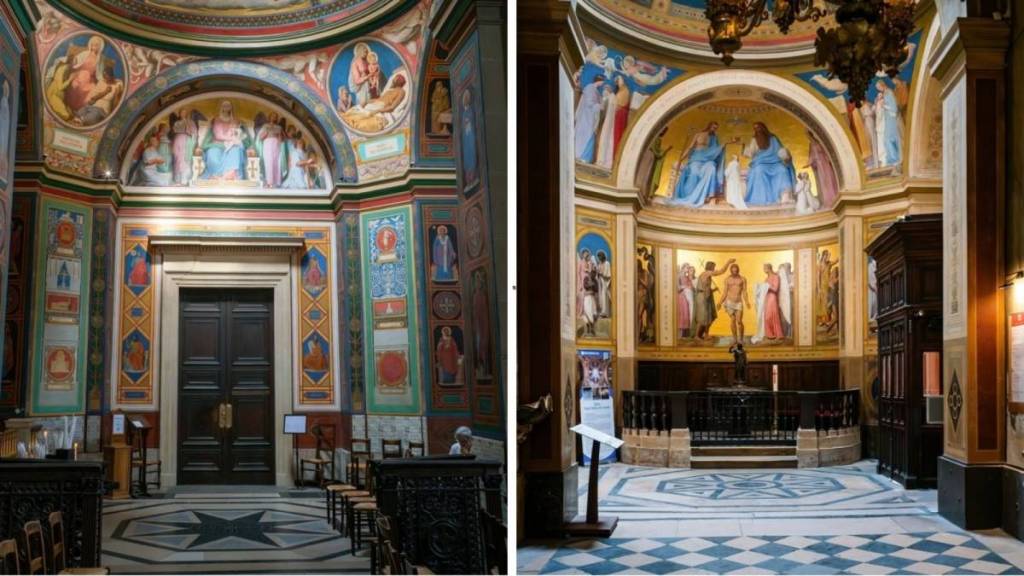
After more than 18 months of restoration work, the heavily blackened paintings in the Chapel of the Souls in Purgatory have regained their original colors, paving the way for a reopening to the public in 2025. The main façade, the sculptures, the choir, and the bell tower have also been restored as part of a major program undertaken by the City of Paris.
Why do people still talk about “lorettes” in Paris?
The church’s name initially refers to Loreto, Italy, and to the tradition of the Holy House of the Virgin. But in the 19th century, it gave rise to an entirely different term in the Parisian lexicon. At the time, the neighborhood attracted many young women who were kept by wealthy men from the capital. Their proximity to Notre-Dame-de-Lorette gradually earned them the nickname “lorettes, ” a term that was subsequently widely adopted in the literature and press of the time.
This history adds another layer to a building that fairly well encapsulates the Paris of the 1830s: a new, fashionable neighborhood, artists, architecture inspired by Rome, and a pronounced taste for grand painted decorations. Even today, Notre-Dame-de-Lorette remains significantly less visited than Saint-Sulpice or La Madeleine, even though its interior is among the most surprising in the 9th arrondissement.
Location: Notre-Dame-de-Lorette Church, 18 bis rue de Châteaudun, 75009 Paris