
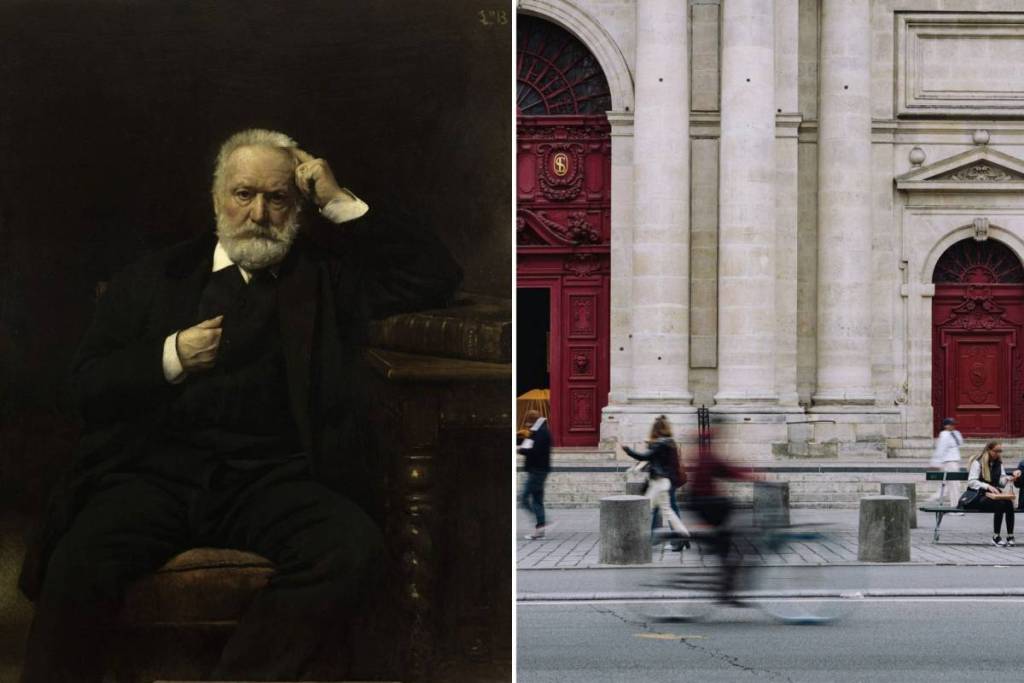

Although he was not born in Paris and lived for many years in exile on the islands of Jersey and Guernsey, Victor Hugo is probably the most Parisian of all writers. He did, in fact, live there for many years; his funeral procession, which wound its way from the Arc de Triomphe to the Panthéon, drew no fewer than three million people, and today, one of the city’s most beautiful avenues bears his name. But what endures, of course, is his work, etched into the streets of the capital for posterity. While *Notre-Dame de Paris* focuses on the cathedral of the same name, and *Les Misérables* on the Petit-Picpus convent, the Luxembourg Gardens, and even the sewers of Paris, there is another place very dear to the author that all Parisians know…
Victor Hugo, the cathedral of French literature
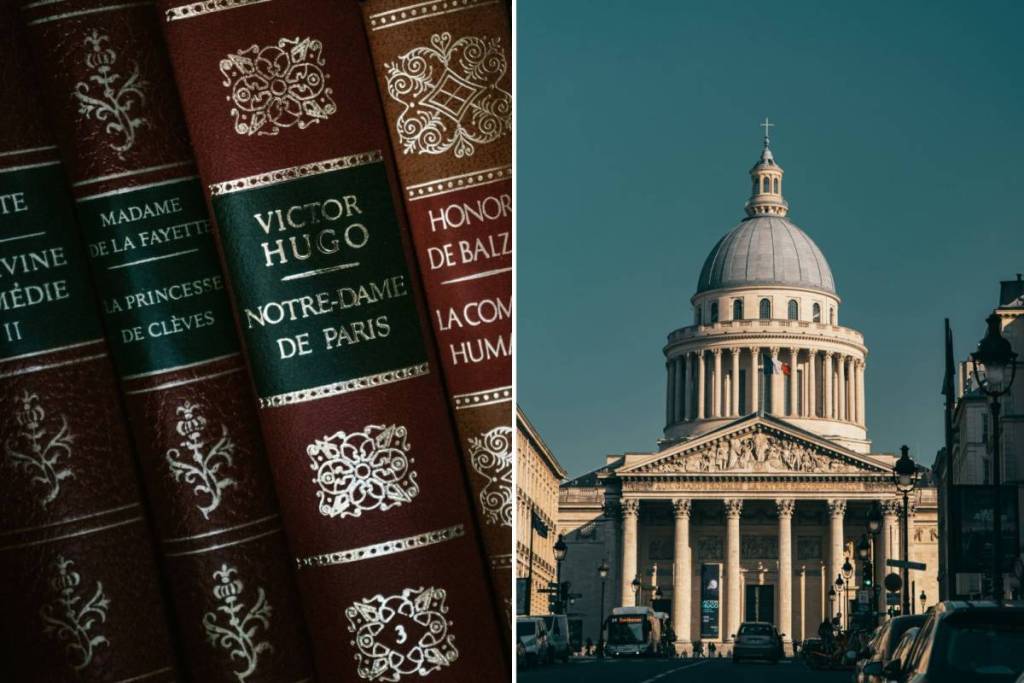
The names of the characters in Victor Hugo’s books all resonate in our collective unconscious. Even without having read the works, we all know that Cosette is synonymous with an abused child, Gavroche with a street urchin, and Quasimodo with the hunchbacked bell-ringer. Try doing that with any other author—you won’t be able to. These few names are just examples, but it is indeed Hugo’s entire body of work that has entered our collective imagination. His writings are like the stones of Paris: they seem to be made of the same, eternal substance.
For if we were to visualize his work, to compare it to something more tangible, Paris would be its perfect embodiment. A unique city—so too is Hugo’s work. A major city—Hugo’s work is unquestionably so. The City of Light—Hugo’s work is that in every sense… So while *Notre-Dame de Paris* is often cited as the sole monument specific to Victor Hugo’s books, another church played a decisive role in his life and writings…
The Church of Saint-Paul-Saint-Louis, the other pillar of Hugo’s body of work

In 1843, Victor Hugo’s daughter, Léopoldine, married Charles Vacquerie at the Church of Saint-Paul-Saint-Louis in a very private ceremony. Victor Hugo, who was living nearby at the Place des Vosges at the time, made this church one of his favorite places. For his daughter’s wedding, he even donated two shell-shaped holy water fonts, which are still there today. Unfortunately, a few months later, Léopoldine died at the age of 19. Her father dedicated Demain, dès l’aube…—his most beautiful poem—to her. It was also here, in this church, that Victor Hugo decided to conclude his masterpiece *Les Misérables* with the marriage of Cosette and Marius. The Saint-Paul-Saint-Louis Church is thus forever linked to the author’s life and work.
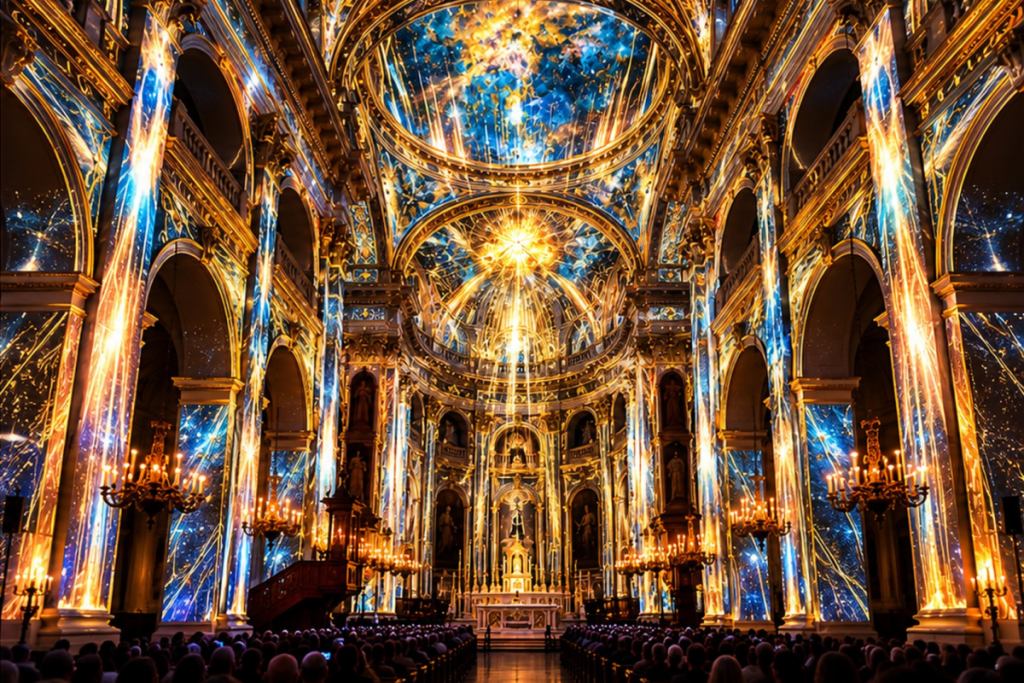
Today, nearly 150 years after his death, the work of this great writer lives on through the show “Saint-Paul by Victor Hugo,” the new monumental production by LUMINISCENCE. The Saint-Paul-Saint-Louis Church is bathed in light through a 360° video mapping display unlike anything seen before, enhanced live by the Aura Vocis choir as well as by André Dussollier, who lends his voice to the show. “This is great, even sublime,” wrote Victor Hugo in *Les Misérables*. Through the power of words yesterday and the power of light today, Hugo’s work is certainly not done transporting us…