
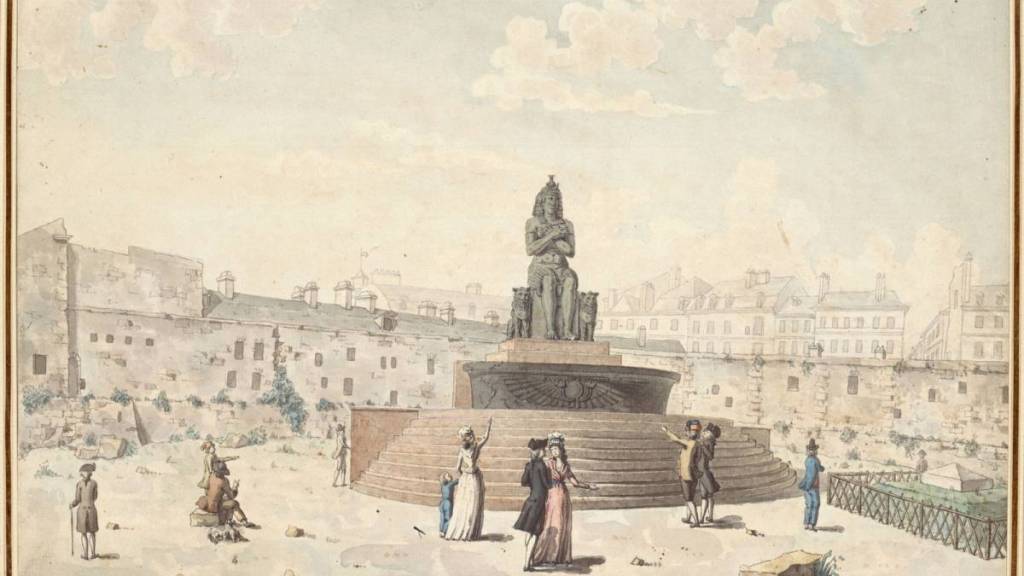

Today, it’s hard to imagine the Place de la Bastille without its immense July Column. Yet, more than 200 years ago, the scene was quite different. Where the monument stands today, there once stood an imposing Egyptian goddess, flanked by two lions. It served as a fountain at the time. Installed in 1793, in the midst of the French Revolution, this structure had been designed for a major national celebration. Behind its appearance lay a very specific symbolism, directly linked to the upheavals France was undergoing at that time.
When the Revolution Drew Inspiration from Ancient Egypt
Its history begins in 1793, four years after the storming of the Bastille. The old prison had been demolished, and the revolutionaries were seeking to give a new identity to this place steeped in history. The painter Jacques-Louis David then conceived a fountain that could be described as original.
The Fountain of Regeneration takes the form of Isis, an Egyptian goddess who embodies motherhood and protection. Set atop a basin, the statue allows water to flow from her breast, under the watchful gaze of two lions positioned at her sides. The statue is unusual, but it takes on its full meaning in the context of the Revolution. Through a maternal figure, the revolutionaries sought to symbolize France’s rebirth after the fall of the monarchy. The water thus symbolizes a new beginning for the nation.
August 10, 1793: A Celebration Like No Other
On August 10, 1793, Paris organized a grand celebration to mark the anniversary of the fall of the monarchy, which had occurred the previous year with the storming of the Tuileries. It was called the Festival of Unity and Indivisibility. Parisians gathered for various ceremonies throughout the capital.
The celebration begins in front of the Fountain of Regeneration. Eighty-six representatives of the primary assemblies step forward toward the fountain and drink the water flowing from its breast. The gesture was considered symbolic because they embodied the whole of France. Through them, the entire nation was meant to be reborn.
Celebrations continued throughout Paris, passing through Place de la Révolution—now Place de la Concorde—then on to Les Invalides, and finally ending at the Champ-de-Mars. This festival provided a backdrop for political spectacle in the capital.
What became of this fountain?
Despite its monumental appearance, the Fountain of Regeneration was not meant to stand the test of time. Built with non-durable materials such as plaster, it deteriorated rapidly. A few years after its installation, the fountain was eventually dismantled and disappeared from the Parisian landscape.
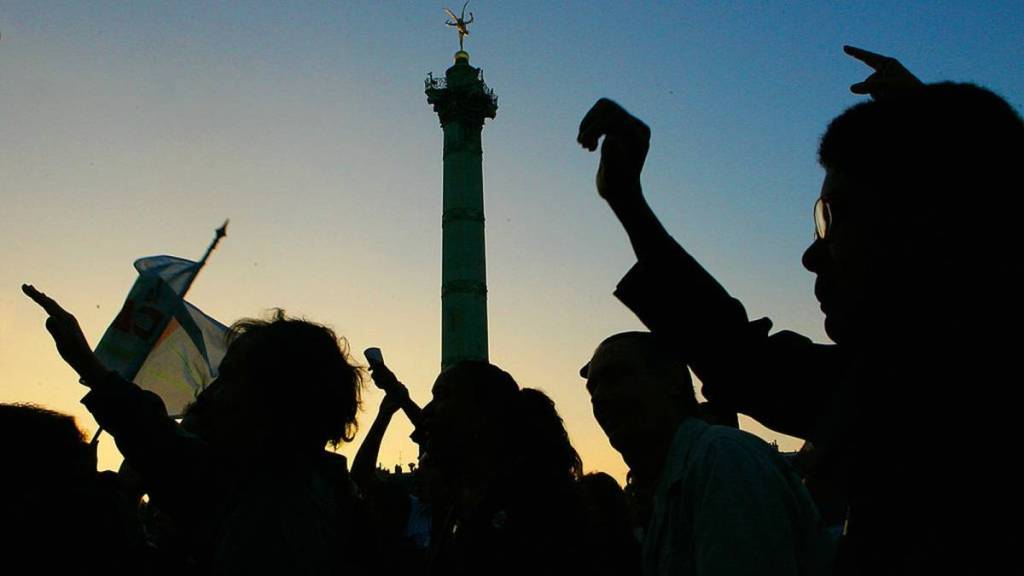
The history of the monuments on Place de la Bastille does not end there. A few years later, in the early 19th century, Napoleon envisioned a monument for this site. He conceived of a new fountain, this one in the form of a giant elephant. The final project never came to fruition, although at that time, a massive plaster model could have been found in the middle of Place de la Bastille. Finally, in 1840, the July Column was erected in tribute to the victims of the 1830 Revolution. Today, only the July Column remains on this historic square.
Today, nothing remains to remind us of this goddess’s presence on Place de la Bastille. Only depictions from that era allow us to discover what this vanished monument looked like.