
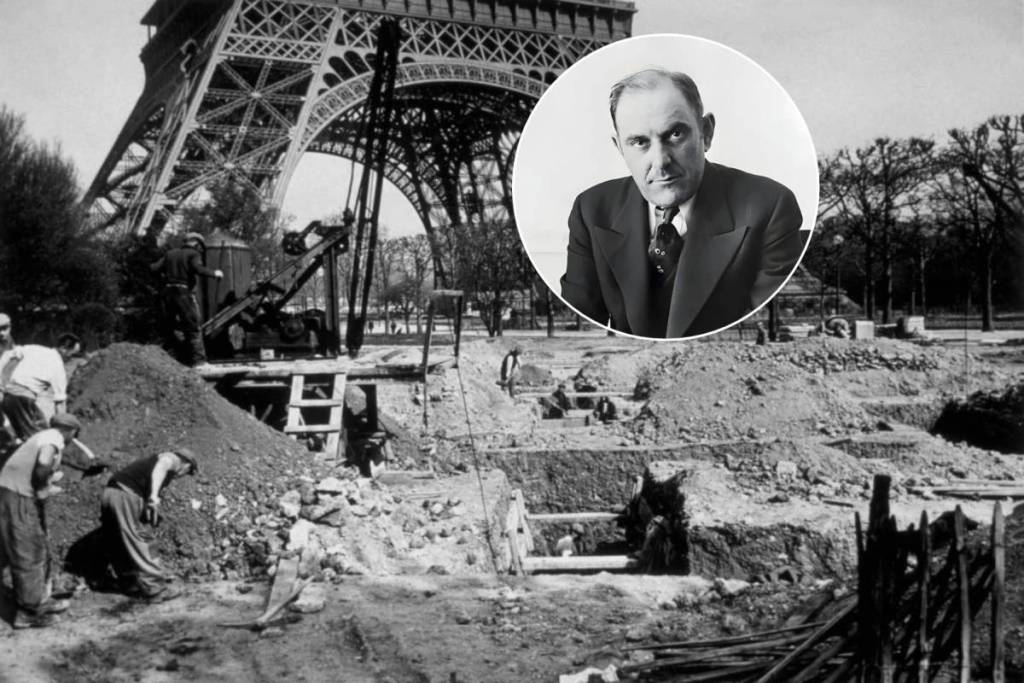

Have you ever heard of Victor Lustig? In 1925, the con artist managed to convince a Parisian scrap metal dealer that he had just purchased the Eiffel Tower—and its roughly 7,300 metric tons of iron. Of course, the City of Paris had no intention of selling the monument. Here’s the story of the most brazen of Parisian con artists.
Like any good con artist, the man posed as a high-ranking government official, used forged official letters, and summoned several scrap metal dealers to a rather posh location—none other than the Hôtel de Crillon.
In 1925, selling the Eiffel Tower wasn’t as absurd an idea as it is today
Gustave Eiffel died in 1923; the Eiffel Tower was only 36 years old at the time. Its upkeep was costly, and the press reported on the financial difficulties surrounding the monument, which was not yet the French symbol we know today. Lustig realized he had a story that was credible enough.
He told the scrap dealers that the decision was confidential but final: the Tower was to be dismantled and its metal sold. Among the men he approached, André Poisson became his target. Poisson ended up paying to secure the deal. By the time he realized he’d been swindled, Lustig had already cashed the money and left France for Austria. It is often claimed that Victor Lustig then sold the Eiffel Tower a second time, but this is a myth, although he may well have tried the same trick again.
The Eiffel Tower was just one episode in an already eventful career of swindling. Lustig used 47 aliases and carried several fake passports. Among his other specialties was a so-called machine capable of reproducing banknotes, sold to victims convinced they had discovered a way to make money.

In the 1930s, he launched a vast counterfeit currency operation in the United States, large enough to attract the sustained attention of the Secret Service. Arrested in New York in May 1935, he even managed to escape a few months later by rappelling down from his prison cell using a rope made from bedsheets, before being recaptured.
He was ultimately sentenced to twenty years in prison and sent to Alcatraz. Due to illness, he was transferred to a federal medical facility in Missouri, where he died of pneumonia in 1947. Even his true identity remains shrouded in mystery: research conducted much later in the town where he claimed to have been born found no formal evidence of his birth there.
A hundred years after his Parisian scam, his name remains most closely associated with this implausible idea that became reality for a few days: successfully making people believe that a private individual could walk away with the Eiffel Tower in pieces.