
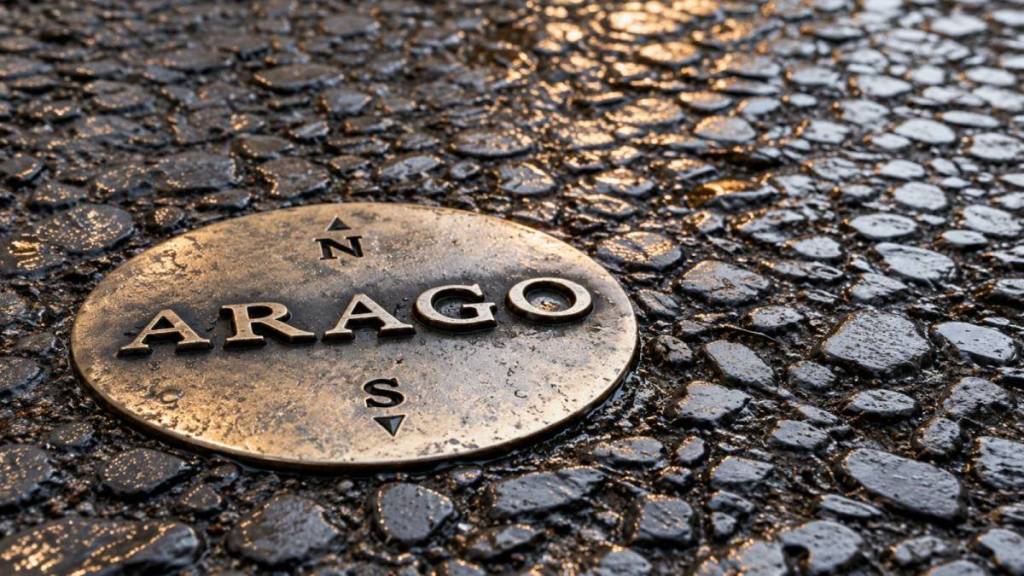

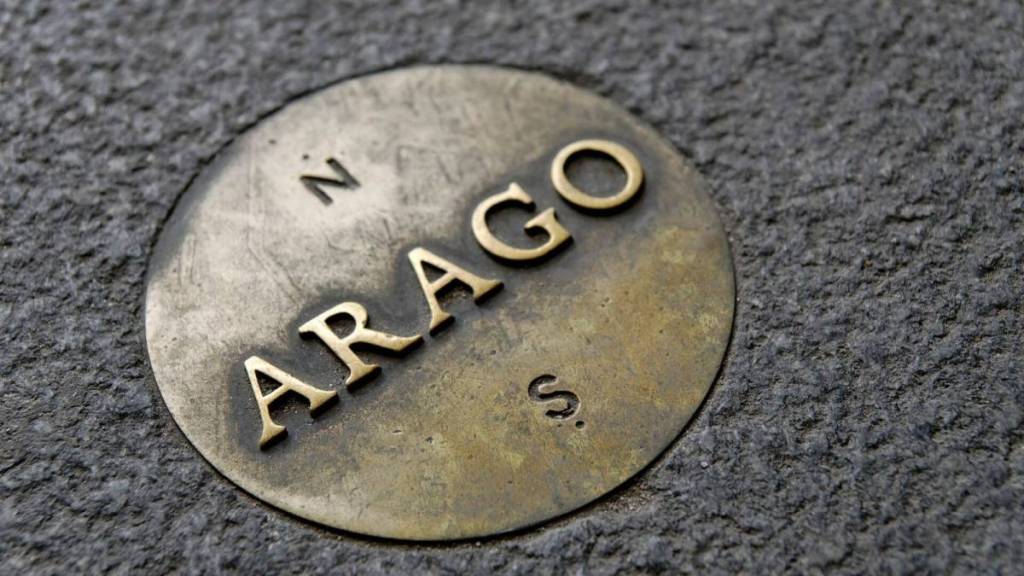
Hidden in Parisian sidewalks, courtyards, and gardens, small bronze medallions bear only the name “Arago,” accompanied by the letters N and S. Yet they mark neither a former address nor a vanished monument: together, they mark the Paris meridian, the north-south line that long served as the reference point for French astronomers.
A total of 135 medallions were installed along this axis, from the Porte de Montmartre to the Cité Universitaire. The work, conceived by Dutch artist Jan Dibbets and completed in 1994, is probably one of the capital’s most unusual attractions.
Why does the name Arago appear on the sidewalks of Paris?
These 12-centimeter-diameter discs pay tribute to François Arago, a French astronomer, physicist, and politician born in 1786. In the early 19th century, the young scientist collaborated with Jean-Baptiste Biot on an impressive surveying campaign aimed at extending the work carried out on the meridian between Dunkirk and Barcelona all the way to the Balearic Islands.
The Paris meridian passes precisely through the Paris Observatory and long served as the reference meridian in France. Greenwich had already been chosen as the international standard in 1884, but France retained its own reference for several more decades before adopting the system linked to the English city in 1911.
A statue of Arago once stood on Place de l’Île-de-Sein, across from the Observatory. Unveiled in 1893, it was removed and melted down during the Occupation in 1942. Its pedestal remained empty, and several decades later, Dibbets’ creation opted for a radically different solution: to replace, in a sense, the vertical monument with a work scattered throughout the city.
From the Louvre to Montsouris Park: A Treasure Hunt in the Heart of Paris
To spot them, all you need to do, in theory, is follow the meridian south or north. Some medallions appear in particularly well-known locations, notably around the Palais-Royal, the Louvre, the Luxembourg Gardens, the Observatory, and Montsouris Park. Nineteen were installed in the latter when the route was first created. There’s even a slight air of mystery surrounding these medallions. They appear notably in the world of *The Da Vinci Code*, where they’re associated with the famous pink line.
It’s not necessarily easy to find all 135 of them today: over the decades, roadwork, relocations, and disappearances have altered the route. This actually makes the walk all the more fun: searching for the Arago markers is like following a centuries-old scientific line through Paris, marked by one of the capital’s most easily overlooked works of public art.
Location: Paris Meridian, from the Porte de Montmartre to the Cité Internationale Universitaire de Paris